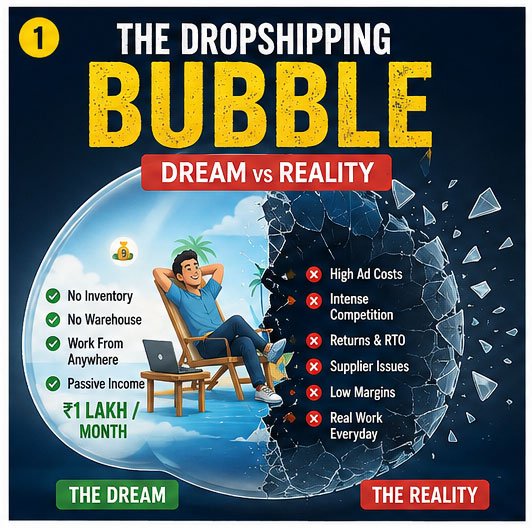
The ₹1 Lakh-a-Month Dream
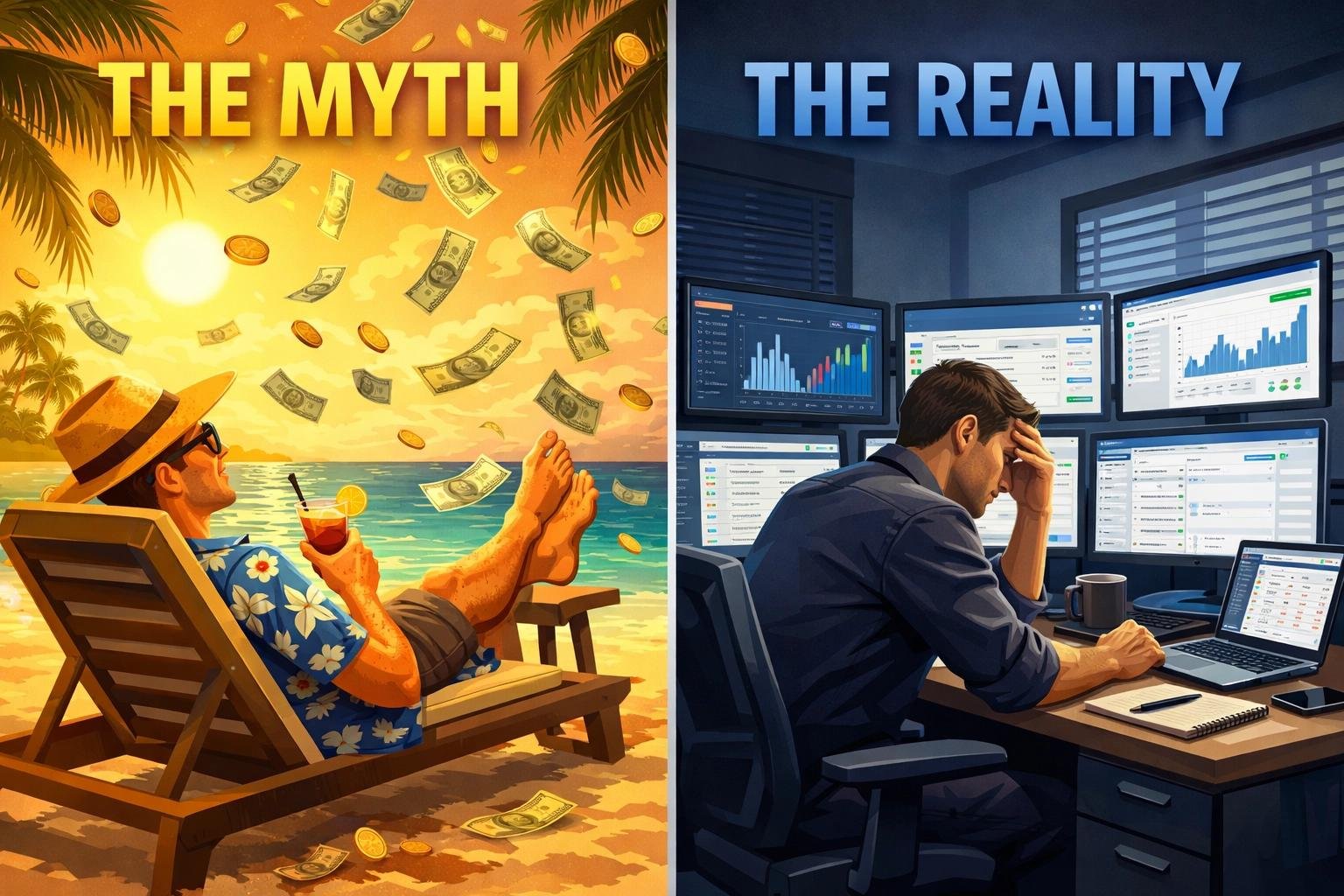
“Start your own online business.”
“No inventory.”
“No warehouse.”
“No manufacturing.”
“No employees.”
“Just choose products, put them on your website and start making money.”
Sounds wonderful, doesn’t it?
This is essentially the dream that has been sold to thousands of aspiring entrepreneurs through dropshipping programs, courses, agencies and “done-for-you” eCommerce packages.
And there is some truth in it.
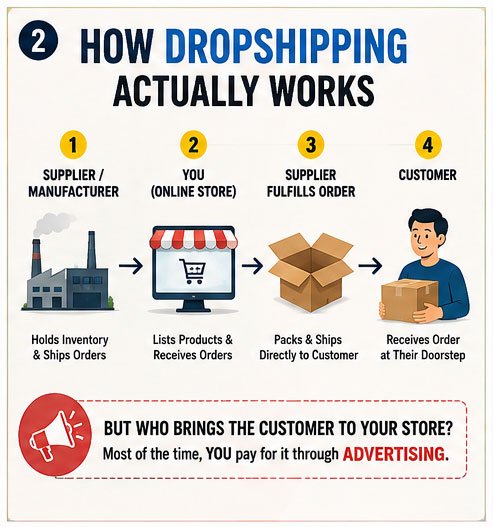
Dropshipping is a legitimate business model. A retailer can sell products without physically keeping inventory, while a supplier or manufacturer fulfils the order and ships it directly to the customer.
The problem isn’t dropshipping itself.
The problem is the dream that has been built around it.
The dream suggests that by paying for a website, subscribing to a dropshipping service and importing a few hundred products, you are suddenly in business.
You aren’t.
You have a website.
And there is a very big difference.
The Part Nobody Wants to Talk About
Let’s imagine someone is attracted by a typical dropshipping opportunity.
They are told:
“You can start with minimal investment because you don’t need to buy inventory.”
Technically, that’s true.
But inventory isn’t the only expense involved in selling products.
You may still need to pay for:
- Domain and hosting
- Website development
- Dropshipping platform or service
- Product sourcing
- Product uploads
- Payment gateway charges
- Shipping
- Returns and refunds
- RTO losses
- Customer support
- Product photography and creatives
- Packaging-related costs
- Taxes and compliance
- SEO
- And, most importantly, advertising
That last one deserves special attention.
Advertising.
This is often where the fantasy meets reality.
Because having 500 products on your website doesn’t mean 500 people are going to visit your website.
Google doesn’t automatically send customers to you.
Instagram doesn’t automatically send customers to you.
Facebook doesn’t automatically send customers to you.
And nobody wakes up in the morning thinking:
“Let me see what products this brand-new dropshipping website has today.”
You need traffic.
And traffic often costs money.
The Hidden Business Model: Someone Has to Find the Customer
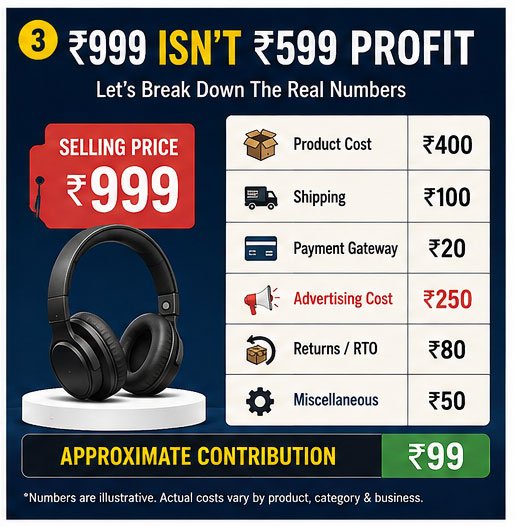
Imagine you find a product from an importer for ₹400.
You put it on your website for ₹999.
Someone tells you:
“Look! You can make ₹599 profit on every sale.”
Sounds fantastic.
But let’s look at the actual numbers.
Suppose your rough economics look something like this:
| Expense | Amount |
|---|---|
| Selling price | ₹999 |
| Product cost | ₹400 |
| Shipping | ₹100 |
| Payment processing | ₹20 |
| Advertising | ₹250 |
| Returns/RTO allowance | ₹80 |
| Miscellaneous costs | ₹50 |
| Approximate contribution | ₹99 |
These numbers are only an illustration. Actual costs vary significantly by product, platform, shipping method, advertising channel and return rate.
But the point is important.
The advertised difference between ₹999 selling price and ₹400 product cost is not your profit.
It is merely the difference between two prices.
Your real business economics begin only after you account for everything required to acquire and serve a customer.
And advertising can completely change the picture.
But Isn’t Dropshipping Supposed to Be “Low Investment”?
Yes.
And this is where we need to be precise.
Dropshipping can reduce the amount of money you need to put into inventory.
That’s a genuine advantage.
You don’t necessarily need to purchase 500 units before knowing whether anybody wants them.
You don’t necessarily need a warehouse.
You don’t necessarily need to pack every order yourself.
You don’t necessarily need to invest heavily in stock.
But reducing inventory investment does not mean eliminating business investment.
You have simply moved the risk.
Instead of risking money on inventory, you may risk money on:
customer acquisition.
And customer acquisition can be expensive.
The Supplier May Already Have the Real Advantage
Here’s the part that deserves more attention.
Imagine an importer brings 10,000 units of a product into the country.
What does the importer want?
To sell those products.
The importer doesn’t necessarily need to build ten thousand individual consumer brands.
Instead, they can offer the products to retailers, resellers and dropshippers.
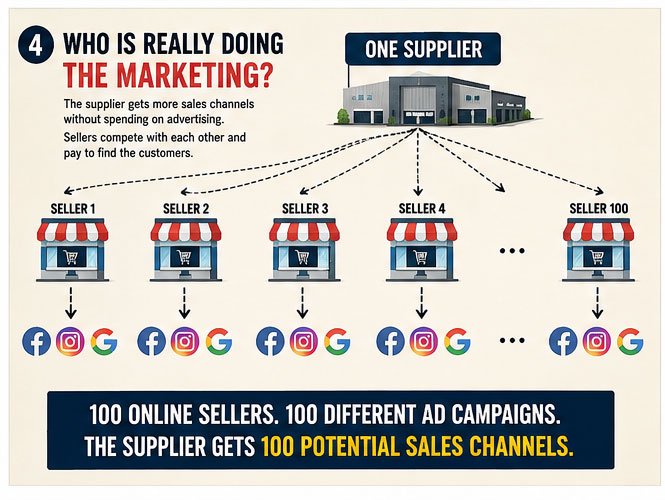
Now imagine 100 different online sellers are promoting the same product.
Each seller creates their own website.
Each seller creates social media advertisements.
Each seller runs Google or Meta campaigns.
Each seller tries different product images.
Each seller experiments with different offers.
Each seller spends money discovering which audience converts.
The supplier doesn’t necessarily have to carry the entire customer-acquisition burden.
The retailers are doing a significant part of the selling work.
This doesn’t mean every supplier is deliberately exploiting sellers.
It simply means that dropshipping can create a very attractive distribution model for suppliers.
The supplier gets more potential sales channels.
The individual seller gets access to products without holding inventory.
Everyone can benefit—provided the economics actually work.
The Real Problem: Everyone Is Selling the Same Thing
Here’s another uncomfortable question.
If your dropshipping provider gives you access to the same catalogue that hundreds of other sellers receive, what makes your business special?
You may have the same product.
The same supplier photos.
The same product description.
The same specifications.
The same price.
Sometimes even the same advertising creatives.
So why should the customer buy from you?
This is where the idea of “just upload products and start selling” falls apart.
Uploading products isn’t building a brand.
Having a website isn’t building a brand.
Installing WooCommerce isn’t building a brand.
Importing 1,000 products isn’t building a brand.
A business needs something that gives customers a reason to choose it.
That could be:
- Better positioning
- Better customer experience
- Better content
- Better pricing
- Better support
- Better product selection
- Better trust
- Better branding
- Better fulfilment
- Better expertise
- Or a genuinely differentiated product
Without differentiation, you may simply be another seller competing for the same customer.
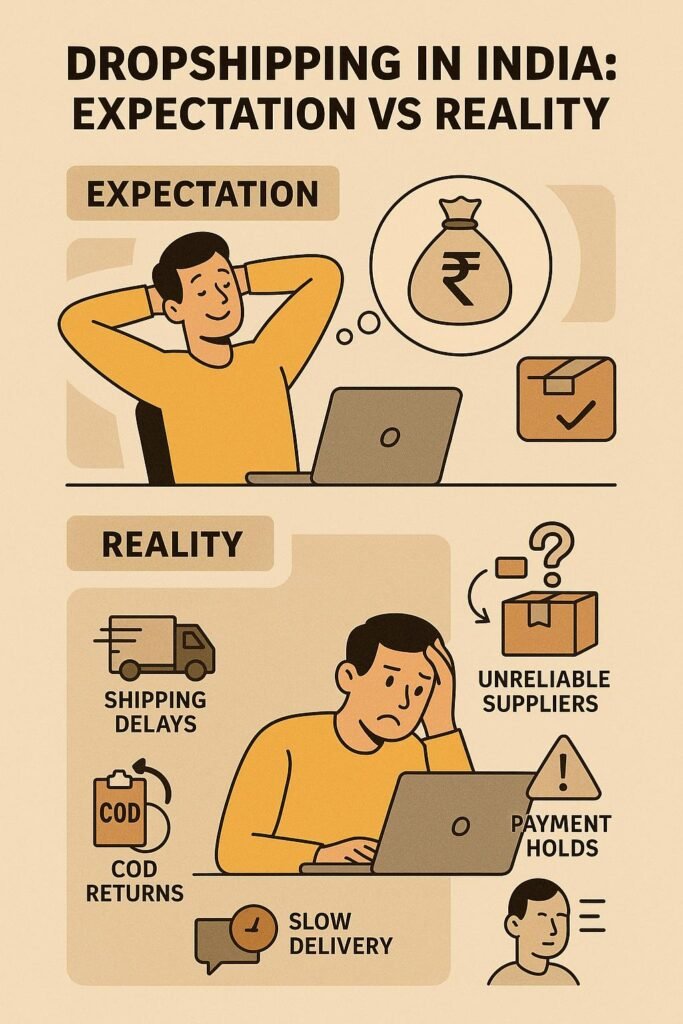
The “Passive Income” Illusion
Perhaps the biggest misconception surrounding dropshipping is the word passive.
A successful online store isn’t passive.
Customers ask questions.
Orders fail.
Payments fail.
Packages get delayed.
Customers change their minds.
Products go out of stock.
Suppliers make mistakes.
Customers want refunds.
Advertising campaigns stop converting.
Competitors reduce their prices.
Platforms change their algorithms.
A product that sold extremely well last month may become completely irrelevant next month.
That’s business.
Not passive income.
You can certainly automate parts of an eCommerce business.
But automation doesn’t remove responsibility.
It simply makes some processes more efficient.
Why People Fall for the Dropshipping Dream
This is perhaps the most interesting part of the entire phenomenon.
The people attracted to dropshipping aren’t necessarily lazy.
Many are enthusiastic.
They genuinely want to earn additional income.
They may have savings.
They may be willing to invest ₹20,000, ₹50,000 or even ₹1 lakh.
But they don’t necessarily want to spend years learning branding, product development, logistics, marketing and customer acquisition.
They want something simpler.
They want to invest money and have someone else handle the complicated parts.
And that’s exactly why the promise is so attractive.
The pitch becomes:
“You invest the money. We handle the business.”
But business doesn’t work that way.
Someone can provide technology.
Someone can provide products.
Someone can provide fulfilment.
Someone can build your website.
Someone can even teach you advertising.
But nobody can guarantee that customers will buy your products.
Before Paying for a Dropshipping Service, Ask These Questions
If you’re considering a dropshipping package, don’t just ask:
“How much does it cost?”
Ask:
1. What exactly am I paying for?
Is it a website?
A product catalogue?
A supplier connection?
Order fulfilment?
Training?
Advertising?
Or simply access to a dashboard?
2. How much will I spend on advertising?
Ask for an honest estimate.
Not:
“You can start with ₹500 per day.”
Ask:
“How much should I realistically budget to test products and find winning products?”
Those are very different questions.
3. How many other sellers have access to the same products?
If 500 other stores are selling the same product, you need to understand how you will differentiate yourself.
4. Who owns the website?
Do you own your domain?
Do you own the hosting account?
Do you have administrator access?
Can you move the website elsewhere?
5. What happens if I stop paying the dropshipping service?
Can you continue selling?
Do you lose your product catalogue?
Do you lose your customer data?
Do you lose your website?
6. What happens when a customer returns an order?
Who pays?
What happens with RTO?
Who handles the complaint?
7. What are the actual margins?
Don’t ask only for the supplier price.
Calculate everything.
8. What happens if the product doesn’t sell?
This is perhaps the most important question.
Because a catalogue containing 10,000 products doesn’t mean you have 10,000 products that customers want.
So, Is Dropshipping Bad?
No.
And this is where I don’t want this article to become another sensationalist attack on dropshipping.
Dropshipping can make sense.
It can be useful for:
- Testing products
- Testing markets
- Starting with limited inventory risk
- Businesses that don’t want to maintain warehouses
- Niche retailers
- Manufacturers expanding their distribution
- Retailers working with reliable suppliers
- Entrepreneurs who understand digital marketing and customer acquisition
The problem begins when dropshipping is presented as:
Easy money + little work + guaranteed demand + passive income.
That’s not a business model.
That’s a fantasy.
There Is a Better Way to Think About Starting an Online Store
If you’re serious about eCommerce, start with a different question.
Don’t ask:
“How can I make money without doing much work?”
Ask:
“What can I sell, to whom, and why would they buy from me?”
That’s the beginning of a real business.
You don’t necessarily need to manufacture your own products.
You don’t necessarily need a warehouse.
You don’t necessarily need thousands of products.
You don’t even necessarily need a huge budget.
But you do need a reason for customers to choose you.
Start small.
Pick a niche.
Research the products.
Find reliable suppliers.
Understand your margins.
Build a professional store.
Test demand.
Spend carefully on advertising.
Measure everything.
Then expand what works.
And If You Don’t Want to Build Everything Yourself?
That’s completely reasonable.
You don’t have to become a web developer, designer, product researcher, SEO specialist and eCommerce expert overnight.
You can outsource parts of the process.
The important thing is to know what you are actually buying.
A website can be built for you.
Products can be sourced for you.
Products can be uploaded for you.
Payment gateways can be configured for you.
Shipping can be integrated for you.
But the business still belongs to you.
You still need to understand your customer.
You still need to market your products.
You still need to monitor your numbers.
And you still need to make decisions.
That’s not a disadvantage.
That’s what owning a business means.
We Would Rather Build Your Store Than Sell You a Dream
This is exactly why we believe there is value in a simpler approach.
If you want to start an eCommerce business, you don’t necessarily need an expensive “dropshipping empire” package.
You may simply need a properly built online store and help getting the initial products and infrastructure in place.
We can help with things such as:
- eCommerce website development
- WooCommerce setup
- Initial product uploads
- Product sourcing assistance
- Payment gateway setup
- Shipping configuration
- Basic store configuration
- Mobile-friendly design
- Product categories and structure
You make the business decisions.
You control the brand.
And most importantly, we won’t promise that putting products on a website will magically make you money.
Because it won’t.
There is no magic button.
There is no guaranteed winning product.
There is no guaranteed ₹1 lakh per month.
There is only a business—and the work required to make that business succeed.
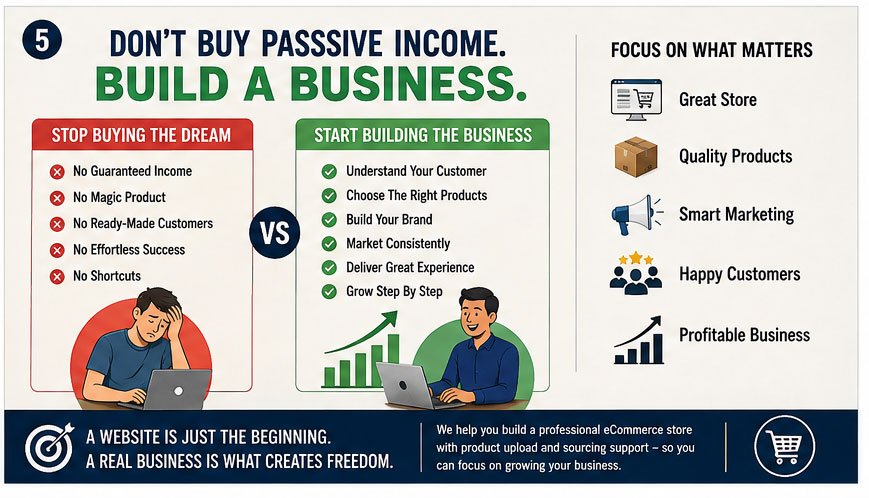
Don’t Buy Passive Income. Build a Business.
The biggest mistake you can make isn’t trying dropshipping.
The biggest mistake is paying someone because you believe they can remove all the difficult parts of entrepreneurship.
They can’t.
A supplier can supply.
A developer can build.
An agency can advertise.
A fulfilment company can ship.
A consultant can advise.
But nobody can manufacture customers.
And customers are ultimately what make an eCommerce business work.
So before you spend your hard-earned money on a dropshipping package, ask yourself one simple question:
“Am I buying a business—or am I buying the tools to try to build one?”
Know the difference.
Because once you understand that difference, the dropshipping bubble becomes much easier to see through.
Build the store. Test the market. Understand the numbers. Build the brand.
And never confuse having an online store with having an online business.
Checkout our website https://www.creativeframes.co.in/